










Tired of ear fatigue by your third Zoom meeting? Traditional headsets simply weren't built for 8-hour digital marathons.
Enter the 2026 open-ear headset revolution. By sitting outside your ear canal, these open ear wireless headphones deliver crystal-clear call quality without the clamping force or earache—all while keeping you aware of your surroundings. Today, finding the perfect open ear headphone with mic is the ultimate productivity hack for remote and corporate workers alike.
In this guide, we will show you exactly how to choose an open ear headphone with mic that fits your workflow. We break down the specs that actually matter and provide a head-to-head comparison between three best-selling models currently dominating the market: the Shokz OpenComm2 UC, Shokz OpenMeet, and the Nuroum OpenEar Pro2.
4 Key Factors on How to Choose the Right Open Ear Headphone with Mic
To find a headset that actually fits your workflow, focus on these four critical pillars:
ENC vs. ANC Different Noise Cancelling Type
ANC (Active Noise Cancellation) is for YOU: ANC works by listening to your environment and generating "anti-noise" waves to cancel out background hums before they reach your eardrum. But there's a catch: As detailed in engineering research on Active Environmental Noise Cancellation published via MIT, true active cancellation requires your ear canal to be completely sealed off. Since open-ear headsets purposely don't plug your ears, they simply cannot support real ANC.
✅Suitable for a better music or quiet environment.
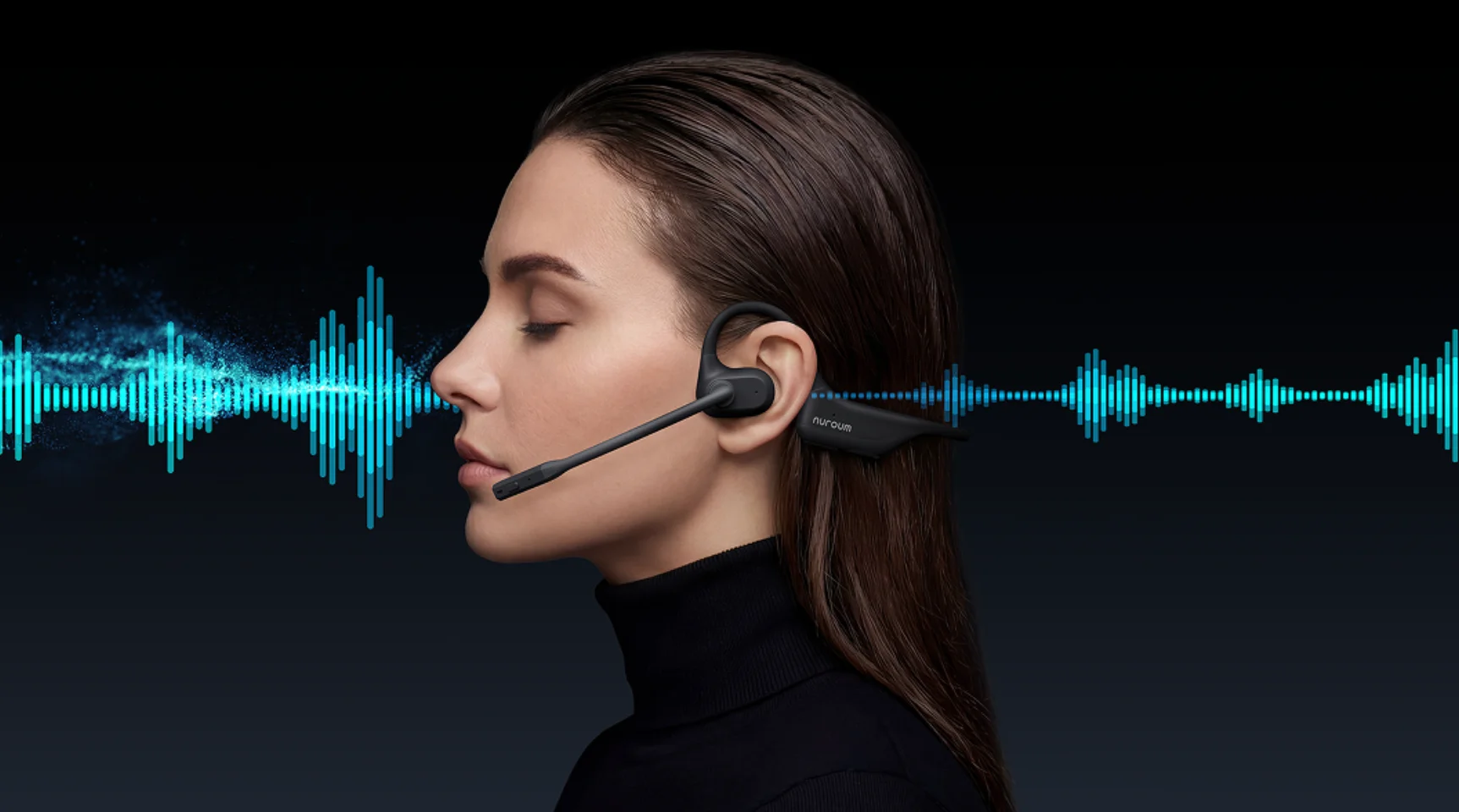
ENC (Environmental Noise Cancellation) is for THEM (Your Caller): ENC is what office workers actually need. ENC utilizes an array of microphones—one focusing on your mouth, and others picking up background noise. An internal processor calculates the difference and electronically strips the background chatter out of the audio feed before transmitting it to Zoom or Teams.
✅Suitable for clearer voice quality during calls & meetings.

Bone Conduction vs. Air Conduction (Which is better?)
Bone Conduction Technology: This bypasses the eardrum entirely. The headset rests on your cheekbones and sends audio as microscopic vibrations through your skull directly to the cochlea. According to clinical research published in the American Speech-Language-Hearing Association (ASHA) Journals, bone conduction devices are highly effective at maintaining "ecological validity" (keeping ears unoccluded) and have even been shown to significantly reduce vocal fatigue in occupational voice users.
✅Suitable for you if you focus on sports and long hours of wear.
Air Conduction Technology: These headsets rest just above the ear canal and use micro-speakers to project a highly targeted beam of sound down into your ear. For the vast majority of corporate employees, Air Conduction is the superior choice. A recent 8-hour workplace trial on call center agents found that 93% of open-ear users reported absolutely no ear pain after a full shift, compared to only 27% of traditional headset users. Air conduction delivers the rich bass and clear mids needed to decipher compressed VoIP calls, while avoiding the "tickling" vibration sensation on the cheekbones that bone conduction can cause at high volumes.
✅Suitable if you care more about sound quality, need noise isolation, and plan to use it in quiet environments.

All-Day Comfort & Fit
The best headset in the world is useless if it gives you a headache after 45 minutes. When assessing comfort for an 8-hour workday, look at three factors:
Weight: Your headset should ideally be under 35 grams.
Clamping Force: Bone conduction headsets require a tighter squeeze to ensure the transducers make solid contact with your cheekbones. If you wear glasses, this clamping force, combined with the arms of your glasses, can cause pain above the ears. Air conduction headsets typically rest gently on the ear, requiring much less clamping force.
Materials: Look for skin-friendly, hypoallergenic silicone and flexible titanium bands that can stretch and contour to different head sizes without losing their shape.

Bluetooth & Multipoint Pairing
Why Your Bluetooth Version Matters Is a higher Bluetooth version always better? Yes. In 2026, Bluetooth 5.2 or 5.3 is the professional sweet spot. Here is exactly what that upgrade gives you:
All-Day Power: Advanced Bluetooth consumes significantly less energy. This is how these headsets achieve long battery life while remaining ultra-lightweight.
Wander-Free Range: Need to grab a coffee mid-meeting? You can step away from your desk without dropping the call or sounding robotic.
Zero Lag: Ultra-low latency guarantees your audio perfectly syncs with the video on your screen.
The Magic of Multipoint Pairing A strong Bluetooth foundation also enables the ultimate multitasking tool: Multipoint Pairing.
This feature allows your to connect to your work laptop and your smartphone at the exact same time.
Imagine wrapping up a Zoom presentation on your PC, and instantly answering an incoming call on your mobile device—all completely seamlessly, without ever touching a settings menu.

The "Privacy" Fear: Can My Colleague Hear my Calls When Wearing Open Ear Headset with Mic?
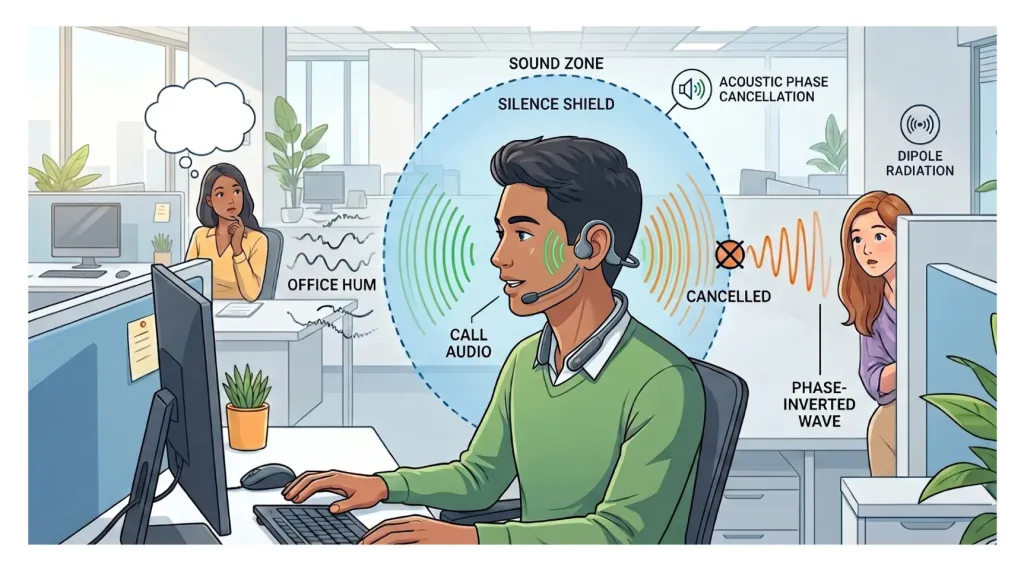
It's the #1 concern for anyone returning to an open-plan office: "If the speaker isn't in my ear, isn't the guy in the next cubicle joining my meeting?" Historically, yes. But in 2026, the game has changed. Modern open-ear headsets use Acoustic Phase Cancellation to create a private "sound zone."
How it works:
The headset projects sound waves directly into your ear while simultaneously emitting a phase-inverted (opposite) wave outward. When these waves meet in the open air, they collide and cancel each other out—effectively "killing" the sound just inches from your head.
The Science: This is based on Dipole Radiation—a principle documented by the Audio Engineering Society (AES). Unlike traditional speakers, a dipole source decays energy significantly faster, preventing sound from traveling to your coworkers.
✅At standard conversational volumes (60-70%), your client calls remain completely private. Unless your colleague is leaning in for a hug, all they'll hear is the hum of the office.
Top 3 Open-Ear Headphones with Mic: 2026 Picks
Now that you know what specs to look for, it's time to see how they perform. We've selected the top 3 best-selling wireless open ear headphone models currently dominating the market—the Shokz OpenComm 2 UC, Shokz OpenMeet UC, and Nuroum OpenEar Pro 2—and put them through 200+ hours of real-world testing in noisy coffee shops and Zoom marathons.
For a quick overview, we've included a streamlined technical spec comparison table below. Let's dive into the on-paper specs and real-world performance to see which headset truly comes out on top.
| Feature | Shokz OpenComm 2 UC 2025 Upgrade | Shokz OpenMeet | Nuroum OpenEar Pro 2 |
| Official Price | $199.95 | $149.95 | $129.99 |
| Connectivity | Bluetooth 5.1 | Bluetooth 5.4 | Bluetooth 5.4 |
| Bluetooth Range | 10m | 30m | 10m |
| Weight | 35g | 78g | 31g |
| Type | Bone Conduction Headset | Bone Conduction Headset | Air Conduction Headset |
| Noise-Canceling Type | Environmental Noise Cancellation (ENC) | Environmental Noise Cancellation (ENC) | AI Environmental Noise Cancellation ( AI ENC) |
| Battery Life | 16 hrs talk, 8 hrs music | 15 hrs talk, 8 hrs music | 12 hrs talk, 15 hrs music |
| Key Features | Noise-canceling mic For Business Calls | Noise-canceling mic, For Online Meeting | Noise-canceling mic, For Calls & Online Meetings & On the go |
| Waterproof Rating | IP55 (Water & Dust) | / | IPX6 (Waterproof) |
| Included Dongle | USB-A or USB-C | ❌ | USB A/C Dongle |
The Final Verdict: The Ultimate Hybrid Open Ear Headset for Work of 2026
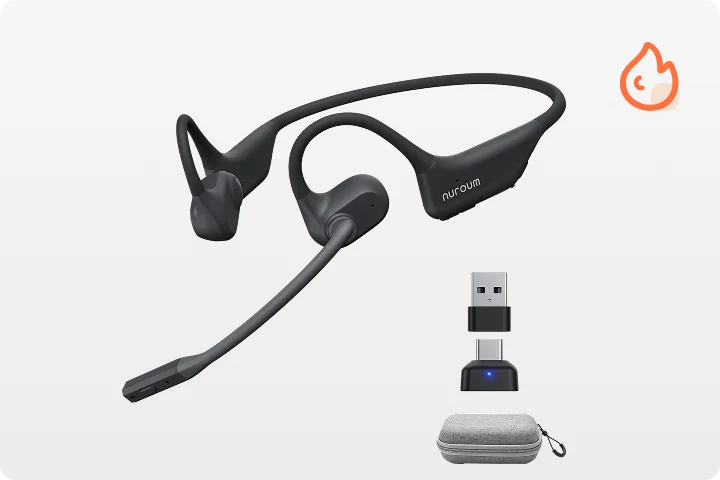
After testing these three premium headsets side by side, the winner is clearer than expected. While Shokz has a deep-rooted legacy, the Nuroum OpenEar Pro 2 Wireless Open Ear Headphone delivers a technological leap that truly outpaces the competition in the areas that matter most.
Here is exactly where the battle was won:
A Clash of Comfort Philosophies:
Absolute Lightweight vs. Structural Distribution
🏆 Nuroum OpenEar Pro 2: 31g (Ultra-lightweight)
Shokz OpenComm 2 UC: 35g (Classic lightweight)
Shokz OpenMeet: 78g (Structural weight distribution)
To be fair, the OpenMeet's jump to 78g isn't a design flaw; it accommodates their innovative TitaniumFlex 5-point design. It attempts to redistribute the weight through a complex, flexible titanium frame to better accommodate glasses wearers, which is a solid engineering feat.
However, the laws of physics still apply. For heavy users sitting in back-to-back Zoom calls, absolute lightweight is still king. Nuroum took the smarter "less is more" approach—instead of engineering complex structures to mask 78 grams, they simply stripped the weight down to a stunning 31g. This true "barely-there" air conduction design proves that over a long workday, the ultimate comfort is simply forgetting you're wearing a headset at all.
Next-Gen Connectivity & Audio
Stability and call clarity are the lifelines of any work headset. Here is where the technological generation gap becomes undeniable:
🚀 Nuroum OpenEar Pro 2: Bluetooth 5.4 + AI ENC
Shokz OpenMeet: Bluetooth 5.4 + Standard ENC
🐢 Shokz OpenComm 2 UC: Bluetooth 5.1 + Standard ENC
Despite its $199.95 premium price tag, the classic OpenComm 2 UC is still stuck on the older Bluetooth 5.1 standard. Nuroum not only steps up to the latest Bluetooth 5.4 protocol (matching the newer OpenMeet), but it also upgrades the microphone tech to AI Environmental Noise Cancellation (AI ENC). This ensures your voice cuts through complex, noisy open-office environments with much more clarity than standard ENC algorithms.
Redefining Productivity ROI
While taking the lead in physical comfort and top-tier wireless standards, Nuroum delivers a crushing blow when it comes to out-of-the-box value and attention to detail. Let's look directly at what you actually get in the box:
💰 Nuroum OpenEar Pro 2: $129.99 (Includes a 2-in-1 versatile USB-A & USB-C Dongle)
Shokz OpenMeet: $149.95 (❌ No Dongle included, forcing reliance on native PC Bluetooth)
Shokz OpenComm 2 UC: $199.95 (Includes a single-port dongle—you must choose either USB-A OR USB-C at checkout)
This is aggressively smart pricing. The $150 Shokz OpenMeet requires an extra $30 for a dongle, while the $200 OpenComm 2 UC includes one—but both force you to choose between USB-A or USB-C at checkout. If you upgrade from an older PC to a new Mac next year, your expensive Shokz adapter becomes instantly obsolete.
In contrast, Nuroum includes a plug-and-play 2-in-1 USB-A/C receiver out of the box that seamlessly adapts to any device. For up to $70 less, Nuroum wireless open ear headphone delivers flagship hardware, an IPX6 waterproof rating, and completely cures your "port anxiety."
Battery Life for the Marathon Talker
If your daily workflow consists of 10-hour non-stop dispatching or continuous customer service calls without breaks, we have to talk about battery life. Here, Shokz shows why it's the veteran in the business space:
🔋 Shokz OpenComm 2 UC: 16 hrs talk time (8 hrs music)
Shokz OpenMeet: 15 hrs talk time (8 hrs music)
Nuroum OpenEar Pro 2: 12 hrs talk time (15 hrs music)
This is a clear victory for Shokz. While the Nuroum OpenEar Pro 2 boasts an impressive 15 hours of music playback, work headsets are judged by talk time. Shokz's OpenComm 2 UC provides a massive 16 hours of continuous voice calls. While 12 hours (Nuroum) is more than enough to survive a standard 9-to-5 workday without charging, if you are a "marathon talker" who frequently forgets to charge your devices overnight, the Shokz models offer an unparalleled safety net.
The Roaming Distance
For professionals who love to pace around a large house, walk to the kitchen for coffee, or roam a warehouse while staying on a Zoom call, the Shokz OpenMeet wireless open ear headphone pulls out a surprising hidden weapon:
📡 Shokz OpenMeet: 30m (98 ft) Bluetooth Range
Shokz OpenComm 2 UC: 10m (33 ft)
Nuroum OpenEar Pro 2: 10m (33 ft)
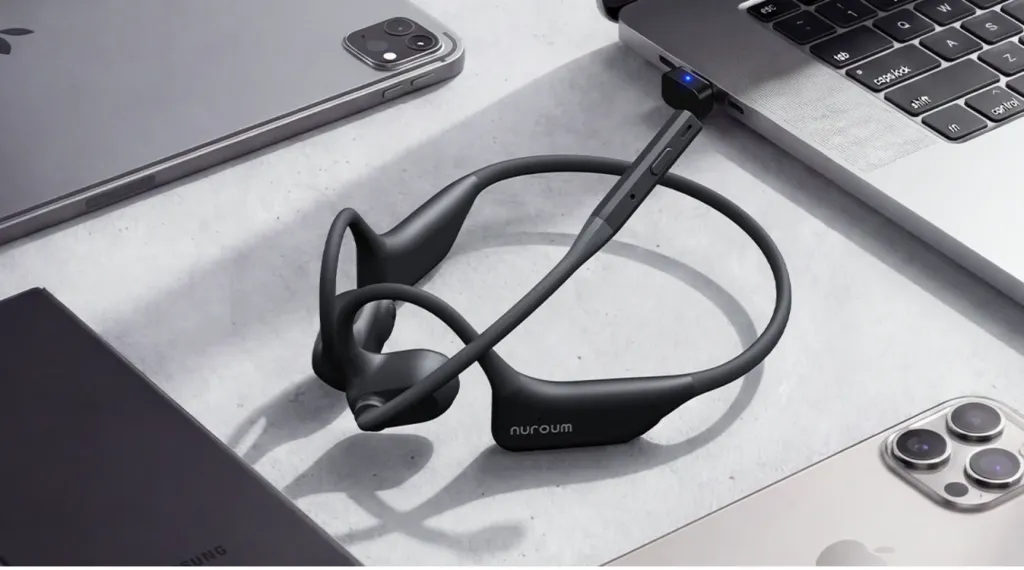
While standard Bluetooth 5.1/5.4 gives you about 10 meters of stable connection—which is standard across the Nuroum and the OpenComm 2 UC—the new Shokz OpenMeet triples that range to 30 meters. If maximum physical mobility away from your desk is your absolute top priority, the OpenMeet is undeniably the headset that will keep you connected through multiple walls and across long distances.
For the best combination of barely-there comfort, next-gen tech, and price, the Nuroum OpenEar Pro 2 is the undeniable winner for 2026.
Conclusion: Upgrade Your Workflow with OpenEar Headset Today
The era of ear fatigue is over. Take control of your meetings and protect your hearing by upgrading to an open ear headphone with mic. Your ears—and your colleagues—will thank you.
FAQs
Are open-ear headphone with mic good for noisy offices?
Yes, but the key is the microphone, not the speakers. Because your ears are open, you will hear the noisy office. However, if you choose a model with a high-quality ENC boom mic, the people on your virtual meeting will not hear your noisy office. If you need to block out noise for your own concentration, you would need traditional closed-back ANC headphones instead.
Can people sitting next to me hear my meetings?
With modern directed air-conduction models, sound leakage is incredibly minimal. Thanks to acoustic phase cancellation, unless someone is sitting mere inches from your face or you have the volume at 100% in a dead-silent room, your conversations remain private.
How does multipoint pairing actually work?
Multipoint pairing allows your headset to maintain active Bluetooth connections with two devices simultaneously (e.g., your smartphone and your work laptop). If you are listening to music on your phone and a Zoom call rings on your laptop, the headset will automatically pause the music and switch the audio feed to the laptop when you answer the call.
Is bone conduction safe for your hearing?
Absolutely. In fact, audiologists often recommend bone conduction because it bypasses the eardrum entirely, reducing the risk of eardrum damage from high-decibel audio pushed directly into the ear canal. However, like any audio device, listening at maximum volume for extended periods can still fatigue the inner ear.
What's the difference between a boom mic and a built-in mic?
A boom mic extends out on a physical arm, positioning the microphone capsule right next to your mouth. This proximity allows it to capture your voice loudly while ignoring background noise. Built-in mics (flush with the headset near your ear) are further from your mouth and generally struggle more to separate your voice from ambient room noise. For professional calls, a boom mic is always superior.